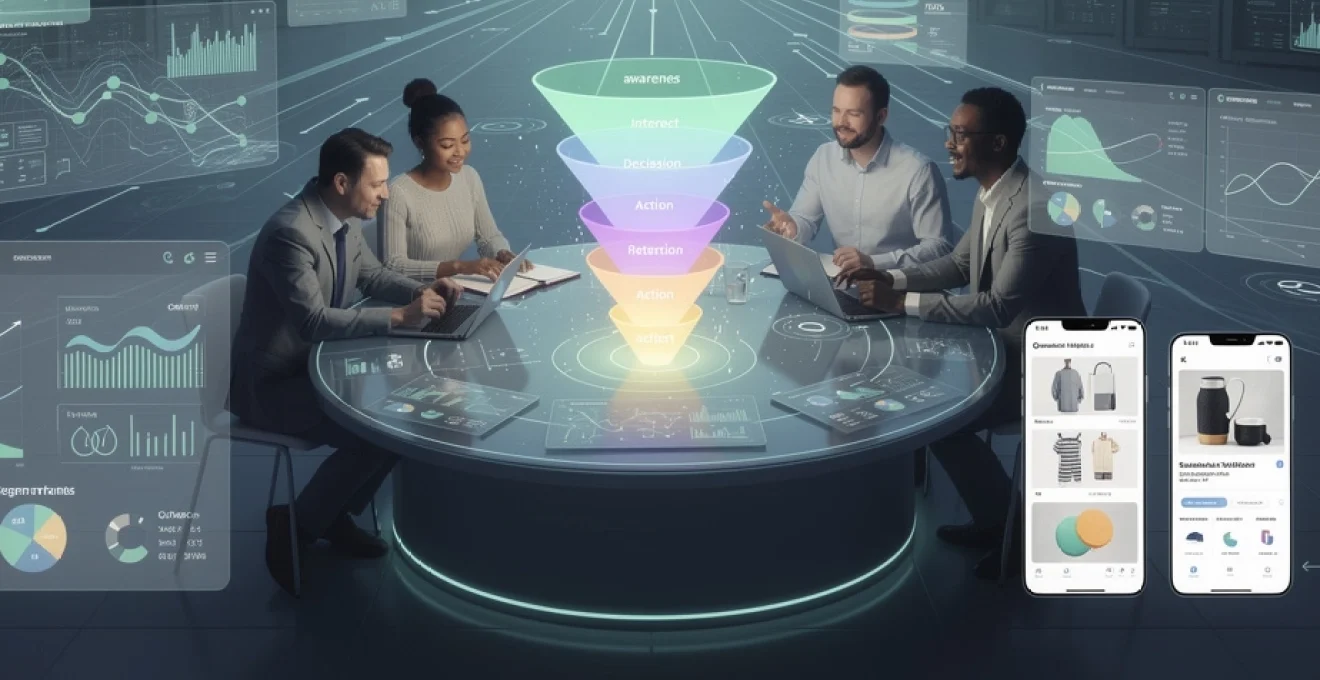
Digital transformation has fundamentally reshaped how businesses approach customer acquisition, engagement, and retention in the modern marketplace. The traditional linear customer journey has evolved into a complex, multi-touchpoint ecosystem where prospects interact with brands across numerous channels before making purchasing decisions. This complexity demands sophisticated funnel optimisation strategies that go beyond basic conversion tracking to encompass comprehensive customer journey orchestration. The stakes have never been higher – companies that master advanced funnel optimisation techniques report up to 67% higher conversion rates and 58% increased customer lifetime value compared to those relying on outdated approaches.
The emergence of artificial intelligence, machine learning, and advanced analytics platforms has created unprecedented opportunities for businesses to understand and influence customer behaviour at every stage of the purchasing process. However, the mere adoption of technology isn’t sufficient for sustainable growth. Success requires a strategic framework that integrates proven psychological principles, sophisticated measurement systems, and personalisation engines to create compelling customer experiences that drive both immediate conversions and long-term loyalty.
Conversion rate optimisation frameworks for Multi-Stage customer journeys
Modern conversion rate optimisation extends far beyond A/B testing landing page headlines or button colours. Today’s successful businesses employ comprehensive frameworks that address the psychological, technical, and experiential factors influencing customer decision-making throughout complex multi-stage journeys. These frameworks must account for the reality that B2B purchasing decisions now involve an average of 6.8 stakeholders and require 17 touchpoints before completion, whilst B2C customers interact with brands across an average of 9.5 different channels during their buying journey.
AIDA model implementation in SaaS acquisition funnels
The AIDA framework – Attention, Interest, Desire, Action – remains remarkably relevant for SaaS businesses when properly adapted for modern digital environments. However, successful implementation requires understanding that each stage now encompasses multiple micro-moments where prospects evaluate value propositions, compare alternatives, and assess risk factors. Contemporary AIDA implementation must incorporate sophisticated lead scoring algorithms that track engagement intensity across content consumption, feature exploration, and social proof validation.
In the Attention phase, SaaS companies must leverage search engine optimisation, content marketing, and paid advertising to capture prospects actively seeking solutions to specific business challenges. The key lies in creating educational content that addresses pain points without immediately promoting product features. Interest cultivation requires progressive value delivery through interactive demos, free tools, and strategic content gates that build trust whilst gathering valuable prospect intelligence.
The Desire phase presents the greatest opportunity for differentiation. Successful SaaS funnels employ dynamic content personalisation based on company size, industry vertical, and demonstrated use cases. This might include customised ROI calculators, industry-specific case studies, or tailored implementation roadmaps. The Action phase must eliminate friction through streamlined trial signup processes, clear pricing transparency, and immediate value delivery within the first user session.
Pirate metrics (AARRR) framework application for e-commerce platforms
The AARRR framework – Acquisition, Activation, Retention, Referral, Revenue – provides e-commerce businesses with a comprehensive structure for optimising customer lifecycle value. Modern implementation requires sophisticated tracking of micro-conversions that predict long-term customer behaviour. Acquisition optimisation now encompasses advanced attribution modelling that accounts for cross-device behaviour and extended consideration periods that can span weeks or months.
Activation metrics have evolved beyond simple first-purchase indicators to include engagement depth measures such as product category exploration, wishlist creation, and social sharing behaviour. E-commerce platforms achieving superior results focus on creating « aha moments » within the first 48 hours of customer interaction, whether through personalised product recommendations, exclusive access offers, or curated content experiences.
Retention strategies must address the reality that acquiring new customers costs five times more than retaining existing ones. Successful e-commerce funnels implement predictive analytics to identify at-risk customers before churn occurs, enabling proactive intervention through personalised offers, customer service outreach, or product recommendations. Revenue optimisation extends beyond transaction value to encompass customer lifetime value predictions that inform acquisition spending and retention investment decisions.
Jobs-to-be-done theory integration in B2B lead qualification
The Jobs-to-be-Done (JT
heory offers a powerful lens for rethinking B2B lead qualification. Rather than segmenting prospects solely by firmographics or budget, JTBD asks a more fundamental question: what progress is this organisation trying to make, in what context, and what’s blocking it? When you map your funnel around the customer’s job-to-be-done, qualification becomes far more predictive because it is anchored in motivation, not just demographics.
Practically, this means enriching your marketing automation and CRM fields to capture job context: triggering events (eg, merger, new regulation), desired outcomes (eg, reduce onboarding time by 30%), and constraints (eg, legacy systems, compliance requirements). High-intent leads are those whose jobs align closely with your core value proposition and where your product removes a key constraint. Sales and marketing can then prioritise these accounts, tailor messaging to the specific job narrative, and design onboarding flows that prove value against the outcomes that actually matter to the buying committee.
Behavioural psychology triggers in freemium conversion pathways
Freemium funnels live or die on behavioural design. You are not just offering free access; you are architecting an experience that nudges users from casual exploration to committed usage and, eventually, to paid conversion. Behavioural psychology provides a rich toolkit of triggers – such as reciprocity, commitment, social proof, loss aversion, and the endowment effect – that can be ethically applied to optimise these conversion pathways.
For example, the endowment effect suggests that people value something more once they feel ownership of it. In a freemium context, this translates into encouraging users to invest early: importing data, inviting teammates, or customising dashboards. Once a workspace feels “theirs,” a paywall that protects advanced features or increased limits frames upgrading as preserving value, not buying something new. Similarly, carefully timed social proof – like “5,327 teams upgraded this month to unlock advanced reporting” – reduces perceived risk at key decision points.
Another powerful lever in freemium conversion is progress visibility. By surfacing usage milestones and gently highlighting what users are missing (“You’re 80% of the way to automating your weekly report – upgrade to schedule it”), you combine goal-gradient effects with loss aversion. The key is to design friction not as a blunt barrier but as a meaningful choice: stay in the free tier with clear constraints, or unlock specific, contextual benefits that align with the user’s demonstrated behaviour and jobs-to-be-done.
Advanced analytics implementation for funnel performance measurement
As funnels become more complex, intuition alone is no longer sufficient to manage them. Sustainable growth depends on rigorous, granular funnel measurement that links channel performance, product usage, and revenue outcomes. Advanced analytics implementations provide both the microscope and the telescope: you can zoom into micro-conversions on a single screen and zoom out to evaluate the entire digital marketing funnel across months or quarters.
The most effective teams treat analytics infrastructure as a core part of their growth stack, not an afterthought. They invest early in clean event tracking, consistent naming conventions, and robust governance so data remains trustworthy as the organisation scales. With this foundation in place, tools like Google Analytics 4, Mixpanel, and Salesforce Pardot can work together to expose bottlenecks, validate hypotheses, and quantify the impact of optimisation experiments on customer lifetime value.
Google analytics 4 enhanced e-commerce tracking configuration
Google Analytics 4 (GA4) represents a significant shift from session-based tracking to an event-driven model, which aligns much better with modern cross-device customer journeys. For e-commerce businesses, enhanced e-commerce tracking in GA4 provides granular visibility into product impressions, add-to-cart events, checkout steps, and refunds – each of which can be mapped to specific funnel stages. Configuring this correctly is essential if you want to move beyond vanity metrics to true funnel analytics.
Implementation typically starts with defining a clear event taxonomy: standardising names for actions such as view_item, add_to_cart, begin_checkout, and purchase. These events should be instrumented via Google Tag Manager or directly in your codebase, with rich parameters like product ID, category, and value. Once configured, GA4’s exploration reports allow you to build path analyses and segment users by behaviour (for example, users who abandoned at the shipping step vs. payment step), making it far easier to identify where small UX improvements could unlock significant additional revenue.
Because GA4 supports both web and app tracking, it is particularly powerful for brands running hybrid funnels where discovery happens on mobile but conversion occurs on desktop, or vice versa. You can analyse how cross-device journeys influence conversion rate, and adjust your full funnel digital marketing strategy accordingly – for example, by using remarketing lists to bring app browsers back to high-intent product pages on the web at the right moment.
Mixpanel cohort analysis for customer lifetime value prediction
While GA4 excels at acquisition and surface-level behaviour, product analytics platforms like Mixpanel are better suited for deep cohort analysis and lifecycle optimisation. By grouping users into cohorts based on actions, attributes, or acquisition channels, Mixpanel allows you to track how retention, engagement, and monetisation evolve over time. This is particularly useful for predicting customer lifetime value (CLV) from relatively early signals.
A common pattern is to create behavioural cohorts based on “activation” events that correlate with long-term value – for example, users who complete three key actions in their first week vs. those who only perform one. Mixpanel can then show you how these cohorts differ in retention curves, upgrade rates, and average revenue per user over months or quarters. With this insight, you can refine onboarding to push more users into the high-value cohort, effectively using analytics to reshape the funnel rather than just observe it.
From a practical standpoint, Mixpanel’s cohort exports can be synced to ad platforms or email tools to drive highly targeted campaigns. Imagine being able to re-engage a cohort whose behaviour indicates they are at high risk of churn before they cancel, or upsell a cohort that has just crossed a usage threshold strongly associated with expansion revenue. In this way, cohort analysis becomes a predictive layer driving proactive growth actions, not just a diagnostic dashboard.
Attribution modelling with salesforce pardot integration
For B2B organisations with long, multi-touch sales cycles, understanding which marketing activities actually move the revenue needle is notoriously difficult. Salesforce Pardot (now Marketing Cloud Account Engagement) helps bridge this gap by tying campaign interactions to opportunities and closed-won deals inside Salesforce. When combined with thoughtful attribution modelling, this integration can transform how you allocate budget across your digital funnels.
Instead of relying only on last-click attribution – which typically overvalues bottom-of-funnel assets like demo request pages – you can experiment with multi-touch models such as linear, time decay, or position-based attribution. These models assign credit to the webinars, whitepapers, nurture emails, and retargeting campaigns that nurture prospects during the consideration phase. Sales and marketing leaders can then make data-informed decisions about where to invest: should you double down on top-of-funnel thought leadership content, or is a bottleneck in mid-funnel lead nurturing limiting pipeline velocity?
The operational win comes from closing the loop between Pardot and Salesforce. By ensuring every lead and contact is associated with campaigns and that opportunity data flows back into Pardot, you build a single source of truth for funnel performance. This enables cohort-level ROI analysis by segment, industry, or product line and provides a defensible basis for shifting spend towards the initiatives that create the most pipeline and revenue, not just the most clicks.
Heat mapping technologies using hotjar and crazy egg
Quantitative analytics tells you what users are doing in your funnel; heat mapping tools like Hotjar and Crazy Egg help you understand why. By visualising where users click, scroll, and hover on key pages, these platforms surface UX issues and behavioural patterns that traditional analytics often miss. Think of them as a CCTV camera inside your funnel, revealing friction points that would otherwise stay hidden.
For example, scroll maps may show that a majority of visitors never reach your primary call-to-action because it sits below an overly long hero section. Click maps might reveal that users frequently click non-interactive elements, signalling confusion about what is actually clickable. Session recordings add even more nuance by letting you watch individual journeys through your digital marketing funnel and identify moments where users hesitate, rage-click, or abandon a process altogether.
Because Hotjar and Crazy Egg are relatively lightweight to implement – often just a single script – they are ideal tools for rapid iteration. You can run an experiment, collect heatmap and recording data for a week, then iterate designs based on observed behaviour. Over time, this continuous loop of qualitative and quantitative insight leads to funnel experiences that feel intuitive to users and systematically reduce conversion-killing friction.
Personalisation engine development for dynamic customer experiences
Static funnels assume that every prospect should see the same sequence of messages and offers. In reality, two visitors who arrive on the same page may have entirely different needs, levels of awareness, and purchasing power. Personalisation engines aim to resolve this mismatch by dynamically adapting content, product recommendations, and calls-to-action based on who the user is and what they have done so far.
Done well, personalisation transforms a generic digital funnel into a tailored journey that feels designed for the individual. This is not just a cosmetic improvement; McKinsey reports that companies excelling at personalisation generate 40% more revenue from those activities than average players. The challenge is to balance sophistication with maintainability, ensuring that your personalisation rules and machine learning models enhance, rather than complicate, your full funnel digital marketing strategy.
Machine learning algorithms in HubSpot smart content delivery
HubSpot’s smart content features allow marketers to serve different versions of emails, landing pages, and CTAs based on list membership, lifecycle stage, device type, or other attributes. When you layer machine learning on top of these rules – either through native predictive features or external models feeding into HubSpot – smart content becomes a true personalisation engine rather than a simple rule-based system.
For example, you might train a model to predict the probability that a lead will book a demo within the next 14 days based on their behaviour (pages viewed, emails opened, interactions with sales). Leads above a certain threshold can then be enrolled automatically into a more assertive nurture stream, with smart CTAs on the website emphasising “Talk to Sales” rather than generic content offers. Over time, the algorithm learns which content variants drive the best outcomes for each segment, creating a feedback loop of continuous improvement.
From a practical standpoint, successful teams start small: they define a narrow use case (such as predicting MQL conversion), connect behavioural data into HubSpot, and test smart content variations with clear success metrics. As confidence and infrastructure mature, more advanced use cases – like predicting churn risk or cross-sell propensity – can be integrated into broader funnel personalisation strategies.
Dynamic product recommendation systems via amazon personalize
For e-commerce and content-heavy platforms, recommendation systems are the engine that powers personalised discovery. Amazon Personalize, built on the same technology used on Amazon.com, enables brands to serve “customers who bought X also bought Y” experiences without building complex machine learning infrastructure from scratch. By ingesting user interactions, item metadata, and contextual data, it can generate real-time recommendations that adapt as behaviour changes.
In the context of a digital marketing funnel, dynamic recommendations can be used at multiple stages. During consideration, they help visitors explore relevant alternatives and accessories, increasing engagement depth and basket size. During checkout and post-purchase, they support intelligent cross-sell and upsell flows that feel helpful rather than intrusive. A visitor who browsed running shoes yesterday and yoga mats today should not see the same product carousel as someone exclusively browsing formal wear – Amazon Personalize makes that distinction automatically.
The key to success lies in feeding the system high-quality, timely data and integrating recommendations seamlessly into the UI. A/B test placements, formats (carousels vs. inline blocks), and messaging (“Recommended for you” vs. “Frequently bought together”) to determine which combinations best support both user goals and revenue targets. Over time, a well-tuned recommendation engine becomes a compounding asset that increases both conversion rate and average order value across the funnel.
Segment-based email automation through mailchimp advanced segmentation
Email remains one of the highest-ROI channels in digital marketing, but batch-and-blast approaches quickly reach their limits. Mailchimp’s advanced segmentation capabilities allow marketers to create highly targeted email automations based on demographics, purchase history, engagement level, and even predicted behaviours like likelihood to purchase again. This transforms email from a blunt instrument into a precise tool for guiding users through each funnel stage.
Consider an e-commerce brand that segments customers into first-time buyers, repeat customers, and high-value VIPs. Each segment can receive a distinct cadence and content mix: first-time buyers get education and social proof to encourage the second purchase; repeat buyers receive early access to new collections; VIPs are invited to exclusive drops and loyalty programs. Mailchimp’s behavioural triggers – such as abandoned cart, product retargeting, and post-purchase flows – ensure that messages are sent when they are most contextually relevant.
Advanced segmentation also supports re-engagement and win-back strategies. By building segments for subscribers who have not opened emails in 90 days, or customers whose last purchase was over six months ago, you can test targeted incentives, surveys, or content designed to revive dormant relationships. When aligned with your broader full funnel digital marketing strategy, these automations help close the loop between acquisition and retention in a scalable, measurable way.
Real-time behavioural targeting with optimizely feature flags
Feature flags are often discussed in engineering circles as tools for safer deployments, but platforms like Optimizely elevate them into powerful levers for real-time behavioural targeting. By controlling which features, layouts, and content blocks are shown to which users at runtime, you can experiment with deeply personalised experiences without redeploying code for every variation.
Imagine being able to show a simplified onboarding flow to users arriving from a mobile ad campaign, while presenting a more advanced dashboard-first experience to returning power users – all controlled via flags and experiments. Optimizely’s platform allows you to define audience rules based on behavioural attributes, campaign parameters, or even external data (like CRM segments), then measure the impact of different experiences on downstream metrics such as activation rate, trial-to-paid conversion, or retention.
Crucially, feature flags support gradual rollouts and canary releases, reducing risk when testing ambitious funnel changes. You might start by exposing a new checkout flow to 5% of traffic segmented by geography or device type, monitor performance in real time, and then ramp up gradually if results are positive. This approach turns your entire product and website into a living laboratory where the digital marketing funnel is continuously optimised through controlled experimentation.
Retention strategy optimisation through customer success automation
While much attention is paid to acquiring new customers, sustainable growth depends heavily on what happens after the first sale. Retention strategies that rely solely on manual outreach from customer success teams do not scale; automation is essential to delivering timely, consistent value at scale without losing the human touch. The goal is to design a retention engine that anticipates needs, surfaces help before issues escalate, and identifies expansion opportunities proactively.
Effective customer success automation begins with clear definitions of health scores and risk signals. These may include product usage frequency, feature adoption, support ticket volume, or NPS trends. By feeding these signals into your CRM or customer success platform, you can trigger playbooks automatically: educational email sequences for under-utilised features, check-in messages when engagement dips, or personalised offers when customers hit usage thresholds that historically precede upgrades.
Automation does not replace human relationships; it augments them. For high-value accounts, automated alerts can notify account managers when key stakeholders stop logging in or when renewal dates approach with unresolved issues. For long-tail customers, well-designed journeys – onboarding checklists, milestone celebrations, periodic Q&A webinars – ensure that even those without dedicated CSMs feel supported. Over time, this systematic approach reduces churn, increases expansion revenue, and turns your existing customer base into a stable foundation for further funnel investments.
Technical infrastructure scaling for high-volume traffic management
As funnel optimisation efforts succeed, they often create a new challenge: infrastructure strain. Campaigns that drive sudden spikes in traffic, viral content that outperforms expectations, or seasonal peaks like Black Friday can all expose weaknesses in your technical stack. Without a scalable infrastructure, even the most sophisticated digital marketing funnel can collapse under its own success, leading to slow load times, failed checkouts, and frustrated users.
Preparing for high-volume traffic requires a layered approach. At the foundation, cloud-native architectures with auto-scaling capabilities ensure that compute resources can expand and contract with demand. Content delivery networks (CDNs) distribute static assets globally, reducing latency and protecting origin servers from surges. At the application layer, performance optimisation – from database indexing to caching strategies and asynchronous processing – keeps critical funnel steps responsive even under load.
Equally important is observability. Real-time monitoring of key metrics such as response times, error rates, and throughput allows engineering and growth teams to detect issues early and correlate them with specific campaigns or funnel experiments. Synthetic monitoring and load testing before major launches can simulate expected traffic patterns, revealing bottlenecks in a controlled environment. In this sense, infrastructure scaling is not just an IT concern; it is a core enabler of reliable, high-performing digital funnels.
Cross-platform integration strategies for omnichannel funnel orchestration
Modern customer journeys rarely unfold on a single platform. A prospect may discover your brand via a social ad, research on mobile, sign up on desktop, engage with your app, and later respond to an email or SMS. Without robust cross-platform integration, these interactions remain fragmented data points, making it impossible to orchestrate a coherent omnichannel funnel experience. The result? Disjointed messaging, inefficient spend, and missed opportunities to build trust.
Omnichannel funnel orchestration starts with a unified customer data foundation. Customer data platforms (CDPs) and well-integrated CRMs act as central hubs where web, app, email, ad, and offline interactions converge into a single profile. With this full view, you can design journeys that respect context – suppressing acquisition ads for existing customers, aligning remarketing with email messaging, and ensuring that a support interaction informs future offers. Integration is not just about plumbing; it is about enabling consistent, relevant experiences wherever your customer shows up.
From a tactical perspective, API-first tools and native integrations between ad platforms, analytics, email, and product systems are key. Standardising identifiers (such as user IDs and consented email addresses) enables reliable cross-channel tracking and attribution. Once this foundation is in place, you can implement sophisticated strategies like channel-specific sequencing (eg, serving an educational video ad before a direct response email) or real-time trigger-based messaging (eg, sending an SMS reminder when a high-value cart is abandoned on mobile). In a landscape where attention is fragmented, brands that orchestrate their digital marketing funnels seamlessly across platforms will be the ones that win durable, profitable growth.